Trading in a recession has remained a major concern in recent years as global markets grapple with persistent inflation, high interest rates, slowing economic growth, and rising geopolitical tensions. Recessions bring higher volatility to financial markets, including forex — creating both risks and opportunities for traders who understand how to navigate rapid price movements and shifting sentiment.
What Is a Recession?#
A recession is a significant, sustained slowdown in economic activity affecting a country or group of countries — typically marked by falling GDP, declining real income, reduced employment, and weaker production and sales. Many statistics agencies define a recession as two consecutive quarters of GDP contraction, though there is no universally agreed standard. Recessions are a normal part of the economic cycle, usually occurring every seven to nine years; most downturns last longer than 100 days, and if a downturn extends for many months or years, it may evolve into an economic depression with broader social and financial consequences.
Pros and Cons of Trading in a Recession#
Pros | Cons | |
|---|---|---|
Volatility | More price swings, breakouts, and short-term opportunities | Cuts both ways — sudden spikes and liquidity gaps can cause sharp losses |
Direction | Safe-haven flows (USD, JPY, CHF, gold) become more predictable | Sentiment becomes unstable — even positive news can trigger negative reactions |
Policy | Central bank actions (rate cuts, QE) can drive strong directional moves | Liquidity may decline during panic phases, widening spreads and slippage |
Style fit | Ideal for short-term, momentum-based strategies (scalping, day trading, news trading) | Requires stricter discipline, tighter stops, and conservative leverage |
How Does Gold Behave When Trading in a Recession?#
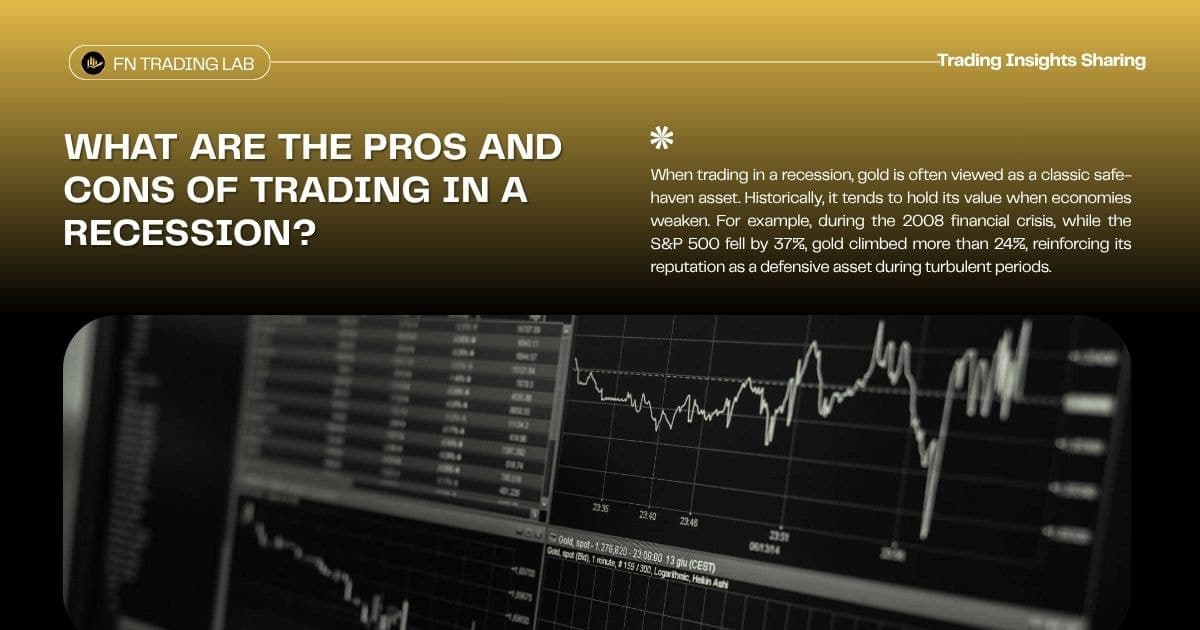
Gold is often viewed as a classic safe-haven asset — historically holding its value when economies weaken. During the 2008 financial crisis, the S&P 500 fell by 37% while gold climbed more than 24%, reinforcing its reputation as a defensive asset during turbulent periods. Gold's resilience comes from consistent demand: central banks continue accumulating reserves, and industries like healthcare and technology rely on it regardless of economic conditions. This behavior is partly psychological — investors expect gold to be safe, so they move into it during downturns, turning it into a self-fulfilling safe-haven.
Even gold doesn't rise in a straight line, though — like any market, XAUUSD experiences peaks and pullbacks. For forex traders, gold's inverse relationship with the US dollar often makes XAUUSD one of the most active instruments during recession-driven volatility. Traders can take positions on gold via CFDs, futures, ETFs, or physical bullion, but strong risk management remains crucial regardless of the method.
Safe-Haven vs. Risky Currencies When Trading in a Recession#
Certain currencies tend to hold their value better during economic uncertainty due to strong financial systems and investor trust. The US dollar (USD) remains the most recognized safe-haven currency, alongside the Swiss franc (CHF) and Japanese yen (JPY) — these often appreciate during downturns as investors move away from riskier assets.
Risky or highly volatile currencies are much more sensitive to economic shocks — typically from countries facing political instability, heavy commodity reliance, or structural economic challenges. Examples include the Brazilian real (BRL), which moves sharply with Brazil's economic and political developments; the South African rand (ZAR), reactive to precious metal price changes; and the Turkish lira (TRY), vulnerable to geopolitical pressure and external shocks. These dynamics directly affect pairs like USD/JPY, CHF/JPY, EUR/USD, and XAUUSD — shifting toward safe-haven currencies during downturns can act as an effective risk-management approach, and this behavior can become self-reinforcing as more traders make the same move.
How Recessions Typically Unfold: A General Pattern#
While every recession has unique triggers, most follow a broadly similar arc that's worth understanding before trading through one:
- Early slowdown signals — leading indicators like manufacturing PMI, yield curve inversions, and slowing employment growth start to weaken, though headline GDP may still look positive.
- Confirmation phase — GDP contracts for consecutive quarters, unemployment rises more visibly, and central banks typically begin signaling or executing rate cuts to support growth.
- Peak pessimism — sentiment bottoms out, often overshooting the actual economic damage; this phase tends to produce the sharpest currency and equity volatility as positioning unwinds rapidly.
- Stabilization and recovery — rate cuts and other stimulus measures start showing effects, safe-haven flows begin reversing, and risk appetite gradually returns.
For traders, the middle two phases (confirmation and peak pessimism) typically offer the most tradeable volatility, while the early and late phases tend to be choppier and less directional — which is part of why recession-era trading rewards patience over trying to catch the exact top or bottom of the cycle.
Is the Forex Market Recession-Proof?#
Not fully, but trading in a recession can offer unique opportunities because currencies react quickly to economic shifts. Forex is global by nature — influenced by interest rates, economic indicators, and geopolitical events rather than a single economy's performance. During major global recessions like 2008 or the COVID-19 downturn, traders typically moved toward safe-haven currencies such as the US dollar, creating opportunities for experienced traders to capitalize on risk-off flows. Central banks often respond to recessions with rate cuts, which can trigger significant currency movements — combined with forex's 24/5 schedule, traders can react quickly to news and adjust strategies.
How to Recession-Proof Your Trades#
- Risk management. Apply strict risk controls to preserve capital during volatile conditions — avoid excessive leverage, use appropriate stop-loss levels, and size positions wisely.
- Diversification. Spread exposure across multiple currency pairs instead of relying on one economy, reducing the impact of a recession affecting a single region.
- Stay informed. Follow economic news, interest rate decisions, and major data releases — including how the US Dollar Index (DXY) reflects broad dollar strength during risk-off periods.
- Adaptability. Be ready to adjust your strategy as recession-driven dynamics shift — what works in expansion periods may fail during downturns.
- Hedging for protection. Taking offsetting positions can reduce the impact of adverse price movements, though it may limit returns in stable conditions.
Recessions Aren't Always Global at the Same Time#
It's worth remembering that a "recession" in forex context is rarely a single global event — different economies enter and exit downturns on different timelines. The US, Eurozone, UK, and Asian economies don't necessarily contract in sync, which is exactly what creates forex opportunity in the first place: if one region is in recession while another remains in expansion, the interest rate differential and growth differential between their currencies can produce a sustained, tradeable trend, rather than the broad "risk-off, buy USD" flow that dominates during a truly synchronized global downturn like 2008 or the COVID-19 shock. Understanding whether a recession is localized or globally synchronized changes which currencies are likely to be the safe-haven beneficiaries versus which are simply reflecting weak fundamentals in one specific economy.
Frequently Asked Questions#
Final Thoughts#
Trading in a recession comes with clear risks — higher volatility, unpredictable sentiment, and sudden policy shifts — but it also creates real opportunities for traders who understand how currencies behave during economic stress. No strategy is completely recession-proof, but staying informed, applying strong risk management, and adjusting your approach as conditions change lets you capture the advantages recessions offer while protecting against the downside.
FN Trading Lab — For Traders and Trading Community