Loading content
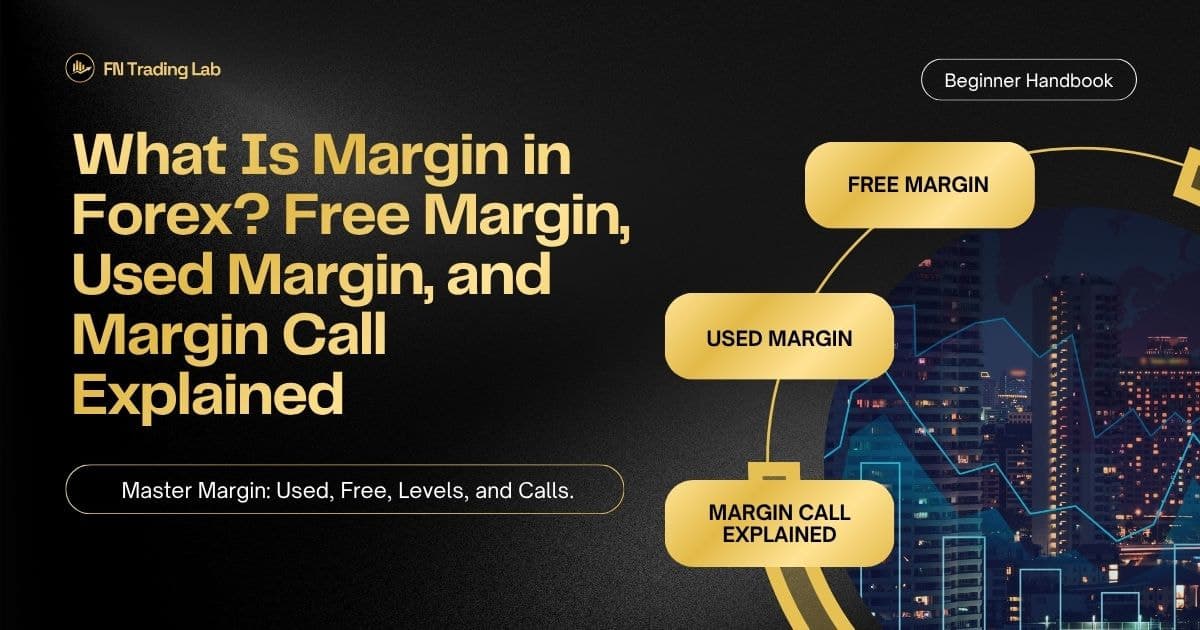
What Is Margin in Forex? Free Margin, Used Margin, and Margin Call Explained
Table of Contents
If you’ve traded forex for more than five minutes, you’ve probably said this at least once:
“How is my trade already closed when I still have money in my account?”
That frustration is what pulls most traders into the topic of how margin works forex.
And honestly, this is where a lot of beginners go wrong. They either:
- Think leverage is "free money" to open massive positions, or
- Ignore their forex margin level completely until the red warning light starts flashing.
The truth is more useful (and less dramatic): margin is a security deposit, not a fee. It is the "skin in the game" your broker requires to keep your positions open. The market isn't trying to hunt your small balance, but if you don't understand your "breathing room," you're essentially trading with a blindfold on.
At FN Trading Lab, we want to ensure you don't trade with a blindfold on. This guide will walk you through the mechanics of free margin, used margin, and margin call explained to help you stay in the green.
What Is Margin in Forex?#
To understand how margin works forex, you have to stop thinking of it as a cost.
In simple terms, margin is a portion of your account balance that the broker "locks" as collateral to maintain a leveraged position.
That includes areas where the broker ensures:
- You have enough "good faith" deposit to cover potential losses
- Your leverage is backed by actual equity
- The broker's own risk is minimized
Why it matters: Forex is traded on leverage. If you want to control $100,000 with only $1,000, the broker needs to know you have enough collateral to handle market swings.
Simple version#
Margin is basically:
- The "locked" portion of your funds
- The "security deposit" for your open trades
This is why understanding the difference between used margin forex and free margin forex matters so much. When people search for margin call explained, what they’re usually trying to understand is: Where did my breathing room go?
How Margin Works Forex: The Mechanics#
Every time you open a trade, a specific amount of money is set aside. This is the used margin forex.
Important reality check
Margin does not always mean you are losing money.
In the context of how margin works forex, think of it like this:
- You open a trade
- The broker "freezes" a part of your balance (Used Margin)
- The rest of your balance is available for new trades or to absorb losses (Free Margin)
That’s a much more useful framework than seeing margin as a "fee" taken by the broker.
Used Margin vs. Free Margin Forex Simply Explained#
Here’s the plain-English version of your account dashboard:
- Used Margin Forex: The total sum of margin currently "tied up" to keep your active trades running. You cannot use this money for new positions.
- Free Margin Forex: Your actual "breathing room." This is the equity available to either open new trades or act as a financial buffer against market volatility.
The formula:
Free Margin = Equity - Used Margin
This is also why free margin forex overlaps heavily with your survival. If your free margin hits zero, you are officially in the "Danger Zone."
Forex Margin Level: The Barometer of Health#
One of the biggest “aha” moments in trading is understanding the forex margin level. This percentage tells you exactly how much "buffer" you have left before the broker steps in.
Why Margin Level matters#
Around specific percentage levels, your account reacts differently:
- Above 200%: You have a substantial cushion.
- 100%: You have zero Free Margin left. You are "locked" out of new trades.
- Below 80% - 50%: You are nearing a margin call.
Frankly, many beginners ignore this number until it’s too late, then feel shocked when their positions start closing automatically.
Margin Call Explained: The Ultimate Ultimatum#
If you want to understand how margin works forex properly, you must respect the Margin Call.
Margin Call Explained#
This usually refers to the point where your forex margin level drops to a specific threshold (e.g., 100%). Your broker warns you that you no longer have enough collateral to support your losing positions.
The Stop Out#
When the situation goes from bad to worse (usually around 50% margin level), the broker triggers a Stop Out. This is when they manually liquidate your trades to prevent your account from going into a negative balance.
Quick Table: Margin Terms and What They Mean#
Common Beginner Mistakes Around Margin#
Let’s be blunt. A lot of "margin call" pain is self-inflicted.
Common mistakes
- Over-leveraging: Using a 1:500 ratio to open a massive lot on a small account.
- Ignoring Spreads: Forgetting that high volatility can widen Forex Spreads and instantly eat your margin.
- No Stop Loss: Letting a "bad trade" run until it eats all your free margin forex.
- "Hope" Trading: Adding more funds to a losing trade just to keep the margin level alive.
The goal of this guide is not to make you paranoid. It’s to make you smarter about how much "weight" your account can actually carry.
How to Protect Yourself (Without Going Extreme)#
You cannot avoid using margin—it’s the whole point of forex. But you can manage it like a professional.
Practical ways to handle margin better:
- Don't use max leverage: Just because you can trade 1:1000 doesn't mean you should.
- Maintain a high Margin Level: Professional traders aim to stay well above 200-500%.
- Monitor News Events: Check Forex Factory before trading; news spikes are margin killers.
- Use market context: Don't open trades during thin Liquidity hours when spreads can spike.
Final Thoughts #
So what does how margin works forex really mean?
It means understanding that your capital is your weapon, and margin is the limit on how you use it. Your forex margin level is your fuel gauge—don't wait for the engine to stop before you check it.
It means you need to:
- Understand your used margin vs free margin,
- Stop entering oversized trades blindly,
- And manage risk like a professional.
If you do that, you won’t avoid every losing trade, but you’ll stop getting caught by the same margin traps over and over.
Ready to protect your capital?
Join the FN Trading Lab community to master risk management and stay in the green. Your capital is your weapon.
—–
FN Trading Labs - for traders and trading community


Start earning rebates on every trade
Open an account with a top broker, or get a free 1-on-1 consultation from our team.

I'm Kelly Nguyen - a CFA, CMT, and MBA-qualified financial analyst and trading educator with over 6 years of hands-on experience in forex, commodities, and risk management. I started my career on the analytical side of institutional finance before shifting my focus to trading education, where I now help retail traders develop structured, disciplined approaches to the markets. At FN Trading Lab, I create content grounded in real market experience - no fluff, no hype. My goal is simple: make serious trading knowledge accessible to serious traders.
CFACMTMBA6+ Years Market Experience
Risk ManagementTechnical AnalysisForex TradingMarket StructureTrading PsychologyDerivatives
Exclusive