If you’re searching for a way to lower your trading costs and your biggest concern is broker transparency, you’re asking the right question.
A lot of retail traders focus only on finding the next "perfect signal." That matters, but for many traders, the bigger issue is this:
- Why am I paying full price for spreads when professionals get discounts?
- Is there a way to earn money even on my losing trades?
- Can I get better support than just a generic chatbot from a massive broker?
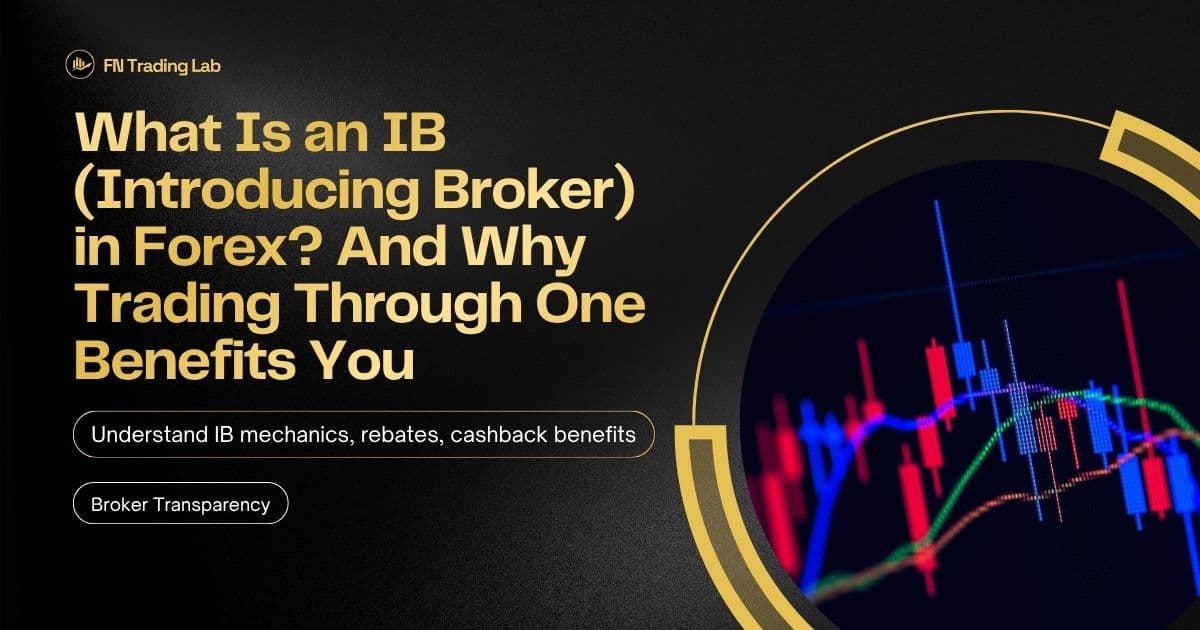
That’s where what is an introducing broker forex becomes a game-changer. An IB isn't a middleman that adds costs; it’s a strategic partner that can turn your trading into a more cost-effective business. Professional traders rarely sign up for a broker account without one, and this guide explains why.
This review is written for the FN Trading Lab audience, especially traders looking to reclaim their trading costs through rebates while maintaining a professional risk-reward ratio.
What Is an Introducing Broker Forex?#
To have what is an introducing broker forex explained simply: think of an IB as a strategic consultant for a major global brokerage. They act as the bridge between you (the trader) and the exchange engine.
- The Broker: Handles the technical "heavy lifting" - platforms, liquidity, and trade execution.
- The IB: Handles the human element - mentorship, customer service, and cost optimization.
The broker pays the IB out of their marketing budget. This means you get a dedicated support team in your corner without paying a single extra cent in fees. It’s essentially a "no-brainer" for any trader looking to scale.
IB Forex Explained: The Win-Win Mechanics#
Many traders wonder, "If it's free, what's the catch?". The reality is simple: most brokers give you one standard price and keep 100% of the spread. When you trade through an IB, the broker shares a slice of that pie with the IB, who then shares it back with you.
To have the IB forex explained properly, you have to realize that traders aren't all the same:
- A Scalper needs every micro-pip back to stay profitable.
- A Day Trader wants to reduce the "toll" paid to the market on every entry.
- A Long-term Investor sees rebates as a way to compound account growth.
This is where the forex introducing broker rebate becomes a practical option—not just because it's "extra money," but because it directly improves your bottom line.
The Forex Introducing Broker Rebate: Your Profit Multiplier#
The forex introducing broker rebate is your biggest competitive edge. Trading without an IB is like leaving a tip on every trade that you could have kept for yourself.
The Real-World Math:
A trader in our community might trade 100 lots a month. Directly, they pay $1,000 in spreads. Through an IB program, they might get $400 back in rebates. That $400 is pure profit that would have otherwise stayed in the broker's pocket.
Quick Comparison: IB vs Broker Forex#
Feature | Trading Direct | Trading Through an IB |
Spreads / Commission | Standard | Identical (No Markup) |
Forex Cashback IB | None | Earned on every single Lot |
Support Level | General Chatbot | Strategic Expert Support |
Effective Cost | 100% Spread | Spread minus Rebates |
How IB Works Forex: More Than Just Cashback#
While the forex cashback IB is a huge draw, a professional IB provides an ecosystem of support:
- Conflict Resolution: If you have a dispute with a broker, a direct client is just a ticket number. An IB client has an advocate with a direct line to broker management.
- Education & Tools: Access to exclusive masterclasses or specialized calculators that aren't available to the general public.
- Transparency: An IB monitors broker behavior to ensure the community is treated fairly, often cross-referencing news on Forexfactory.
IB vs Broker Forex: Safety and Transparency#
When comparing IB vs broker forex, remember they are a team, not competitors. However, a professional setup requires picking the right partners. You might choose institutional-grade execution or the account flexibility found in our HFM review.
Regardless of the choice, a professional IB setup brings these Pros and Cons:
- Pros: Significant cost reduction, zero extra cost, and localized advocacy.
- Cautions: Always choose a "No Markup" IB to avoid padded spreads. Don't let the quest for forex cashback IB lead to overtrading—your strategy still comes first.
Final Thoughts#
If your target profile is traders who want to manage trading as a business, an Introducing Broker is an essential tool.
The biggest strength of this model is simple: An IB gives you a migration path to lower costs. It allows you to keep more of your hard-earned pips and gain a professional advocate.
At FN Trading Lab, our approach is clear:
- Choose a top-tier regulated broker.
- Connect through a transparent IB.
- Optimize your risk-reward ratio by reclaiming your rebates.
Stop flying solo. Build your process, claim your rebates, and trade with an edge.