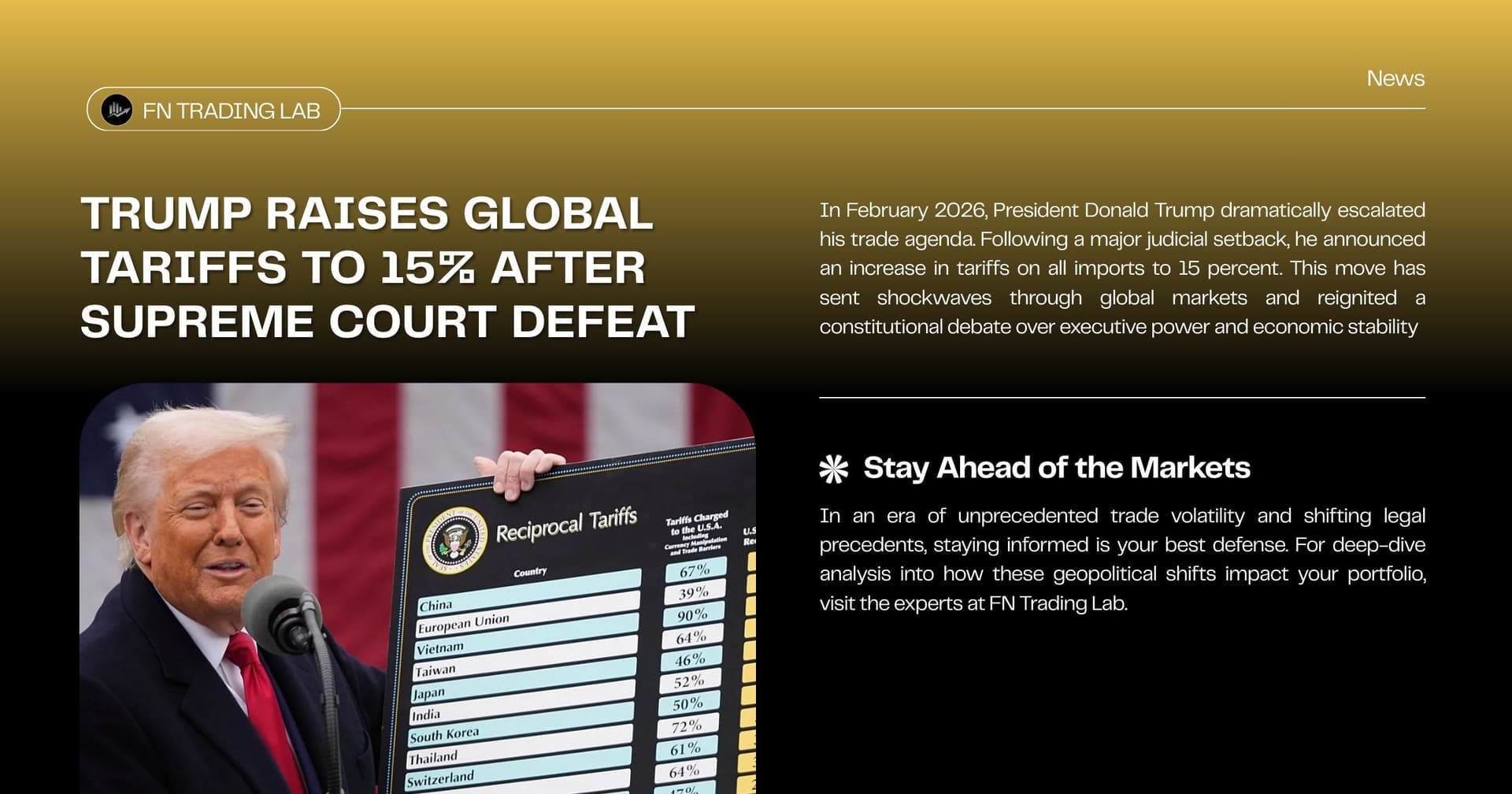
In February 2026, former U.S. President Donald Trump dramatically escalated his trade agenda by announcing an increase in tariffs on all imports to 15 percent, a move that immediately shocked global markets and reignited debates over executive power, international trade policy, and economic stability. The tariff hike came just one day after a U.S. Supreme Court ruling struck down his sweeping import taxes as unconstitutional — setting the stage for a major confrontation between the executive branch, the judiciary, and Congress.
This article breaks down the background, legal context, economic impact, global reaction, and future outlook of the tariff escalation — including why it matters to businesses, consumers, and governments worldwide.
1. Background: The Shift Toward Protectionism#
Tariffs — taxes on imported goods, have been a central component of Trump’s trade strategy during both his first and second terms in office. Under Trump, the United States shifted away from decades of reliance on free trade agreements toward a more protectionist approach, arguing that high tariffs are necessary to combat trade deficits, protect domestic manufacturing jobs, and respond to what he has called “unfair” trade practices by foreign countries.
In 2025, Trump initiated broad tariff increases — sometimes exceeding 25 percent on key trading partners — including Canada, Mexico, China, and Brazil. These measures were justified by Trump using emergency powers that he claimed allowed the president to unilaterally impose tariffs without congressional approval. This legal approach set the stage for a landmark Supreme Court clash over presidential authority.
However, critics — including economists and legal experts — warned that these tariffs would disrupt global supply chains, raise prices for American consumers, and violate established trade rules. The sheer scale and legal basis for these tariffs made them unprecedented in modern U.S. history.
2. The Supreme Court Ruling: Learning Resources, Inc. v. Trump#
On February 20, 2026, the U.S. Supreme Court delivered a 6-3 majority ruling that Trump overstepped his authority.
Key Ruling: The Court found that the International Emergency Economic Powers Act (IEEPA) was intended for narrow national emergencies (like wartime sanctions), not sweeping economic policy. Chief Justice John Roberts emphasized that the power to tax—including tariffs—belongs explicitly to Congress.
3. The Pivot: Section 122 of the Trade Act#
Defying the Court’s restriction, Trump invoked Section 122 of the Trade Act of 1974 on February 21. This statute allows for temporary tariffs of up to 15% to "protect American producers" and rectify trade imbalances.
Key Constraints of the New 15% Tariff:#
Feature | Detail |
Duration | Limited to 150 days without Congressional extension. |
Legal Basis | Relies on Section 122 (Trade Act) rather than IEEPA (Emergency). |
Potential Exemptions | National security goods (minerals/pharma) and USMCA partners may seek relief. |
4. Economic & Political Impact#
Domestic Consequences#
- Cost Burden: Studies show approximately 90% of tariff costs are paid by U.S. businesses and consumers, not foreign exporters.
- Refund Demands: The U.S. Chamber of Commerce estimates over $130 billion in invalidated tariffs may now be owed back to importers.
- 2026 Midterms: With elections approaching in November, tariffs have become a primary political battleground regarding inflation and "economic sovereignty."
Global Reactions#
- Europe: German Chancellor Friedrich Merz warned that unpredictability is damaging global supply chains, while French President Macron praised the U.S. judicial checks and balances.
- Asia: Export-driven economies in China and the ASEAN region face renewed pressure to diversify supply chains away from the U.S. market.
5. Global Reaction: Allies, Adversaries, and Trade Partners#
The international response to the tariff escalation has been mixed, ranging from concern to outright condemnation.
5.1 European Union and Major Allies#
European leaders have expressed deep concern about the uncertainty the tariff increases create for international trade. German Chancellor Friedrich Merz warned that tariff unpredictability is harmful to global supply chains, while French President Emmanuel Macron hailed the Supreme Court decision as a demonstration of democratic checks and balances.
European businesses, like their American counterparts, argue that tariffs disrupt long-term planning and investment, weaken growth, and ultimately make goods more expensive for consumers on both sides of the Atlantic.
5.2 China, Asia, and Emerging Markets#
Countries in Asia — particularly export-driven economies such as China, Japan, South Korea, and members of ASEAN — face renewed pressure as U.S. tariffs make their goods comparatively more expensive in one of the world’s largest markets. Analysts note that ongoing uncertainty could drive investment away from traditional supply chains or accelerate diversification.
5.3 Trade Agreements and WTO Implications#
While Trump’s tariffs under Section 122 may apply broadly, they occur against the backdrop of existing trade agreements and World Trade Organization (WTO) norms. Trade specialists warn that unilateral tariff increases risk retaliatory measures, legal challenges at the WTO, and erosion of long-standing trade cooperation frameworks.
6. The Future of U.S. Trade Policy#
The judicial precedent set by the Supreme Court decision could shape trade policy for years. While the Section 122 tariffs create a temporary workaround, many legal challenges loom:
- Court battles over tariff refunds for importers who paid under the invalidated emergency tariffs may stretch into years of litigation.
- Congressional action to extend or limit tariff authority could become a central political fight.
- Future presidents — regardless of party — may find themselves constrained by this ruling when contemplating broad economic measures without legislative support.
Economists and trade law experts also argue that future tariff strategies will have to rely more on established statutes like Section 301 (retaliation against unfair trade practices) or Section 232 (national security grounds), both of which come with formal investigation and procedural requirements that reduce executive flexibility.
Conclusion: A Period of Volatility#
The 15 percent global tariff announced by Donald Trump marks one of the most contentious shifts in U.S. trade policy in decades — one that highlights deep tensions between presidential authority, legislative power, and global economic integration. The Supreme Court’s rebuke of his previous tariff regime underscored constitutional limits, while the new tariff approach underscores the ongoing conflict between protectionism and market openness.
The long-term impact of this tariff escalation — on U.S. competitiveness, consumer prices, international diplomacy, and global economic stability — remains uncertain as legal challenges play out and governments around the world adapt their responses. Yet one thing is clear: the era of predictable, rules-based trade has entered a period of volatility — and businesses, policymakers, and citizens alike are bracing for the consequences.
Stay Ahead of Market Volatility#
Navigating rapid shifts in trade policy and global market reactions requires expert analysis and real-time data. For deeper insights into how these geopolitical shifts affect your portfolio, visit the FN Trading Lab news.
—–
FN Trading Labs - for traders and trading community